By Landan Dory, Founder & CEO, North Star Brokerage & Advisory
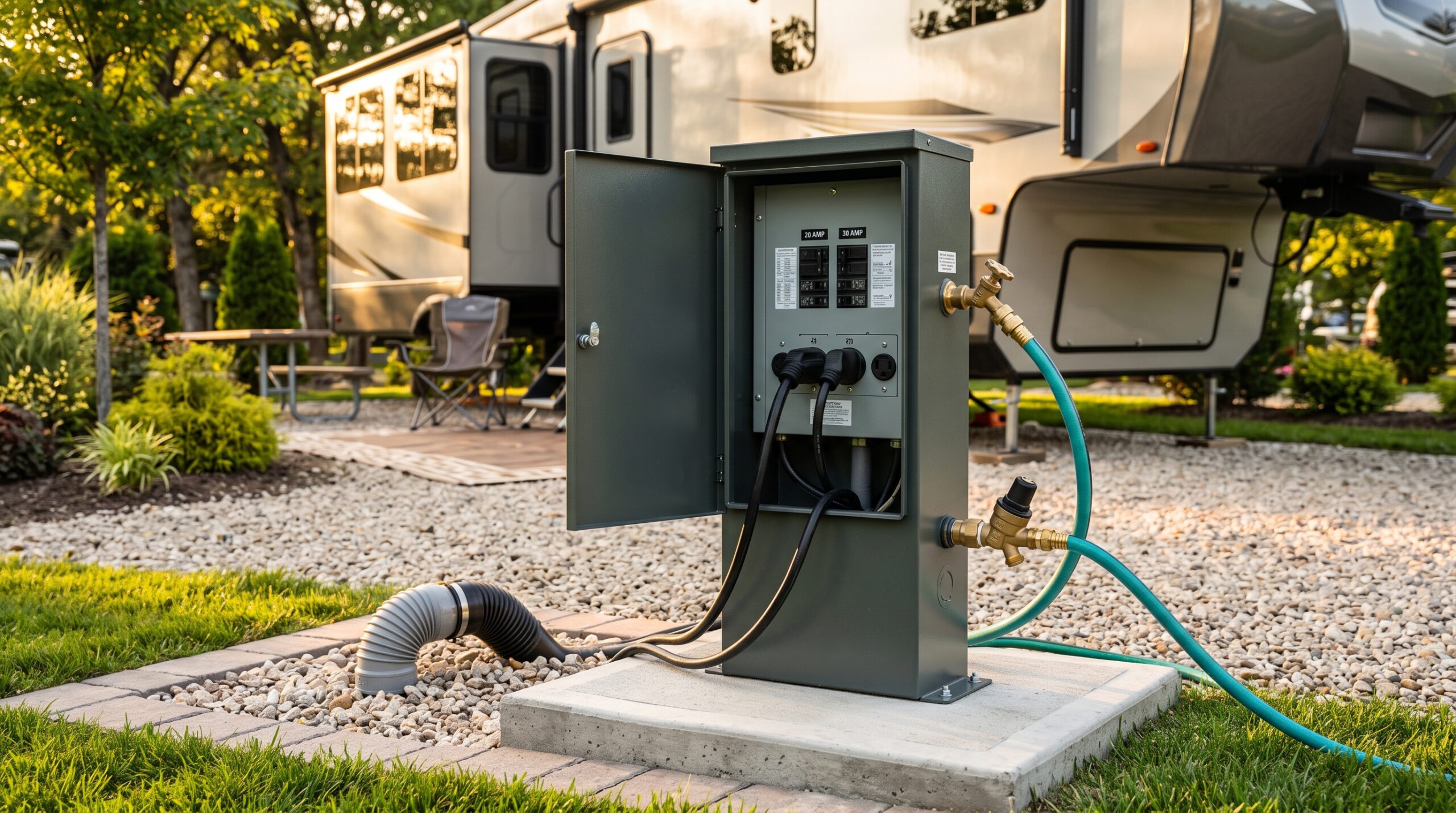
Starting with model year 2028, every new RV with 30- or 50-amp shore power has to leave the factory with a Grounding Monitor Interrupter (GMI). Those units are expected on the road by mid-2027. A GMI tests the pedestal before it lets power into the coach. If it finds a bad ground, reversed polarity, voltage on the ground wire, or voltage out of range, the RV gets no power.
The device doesn't cause electrical problems. It exposes them. In OHI's words, a GMI "isn't going to punish parks that don't have issues - it's just going to make the issues that do exist impossible to ignore." Hidden infrastructure risk is about to become visible to guests, insurers and buyers.
Where the Requirement Came From
The rule sits in Article 551 of the National Electrical Code (NFPA 70), which covers both RVs and RV parks. RVIA member manufacturers pledge to build to adopted standards, including the NEC and NFPA 1192, and face unannounced plant inspections.
Timeline, per RVIA:
-
2023 NEC
The old "reverse polarity device" requirement was replaced with a "loss-of-ground device." No such device was commercially available, so enforcement was pushed to January 1, 2026.
-
2026 NEC
Published late September 2025. The device was defined as a GMI, in Section 551.40(D).
-
RVIA Board
After listed GMIs still weren't ready, the Board set an effective date of January 1, 2027, with mandatory enforcement at the start of each manufacturer's model-year 2028 production.
The GMI goes in the RV, not the pedestal. Parks don't install GMIs, and older RVs don't have to be retrofitted.
Why It Was Adopted
The target is "hot skin," where an RV's metal exterior or frame becomes energized. In 2014, a 3-year-old in Amboy, Illinois, was killed touching his family's camper while standing on wet ground. The trailer was poorly grounded and had been plugged into a rusty outlet with a broken ground wire.
RVIA says damaged power cords and "dog-bone" adapters were the most common reasons for the change. Alternatives were rejected: GFCIs on 30/50-amp pedestal receptacles would nuisance-trip from normal RV leakage, and a reverse polarity device doesn't stop hot skin.
Waterfront parks face a separate hazard - electric shock drowning (ESD), where current leaking into water paralyzes swimmers. NFPA says many cases likely go unrecorded because they are logged as drownings. GMIs don't address ESD. Docks fall under NEC Article 555 and need their own inspection.
What Typically Fails in Park Wiring
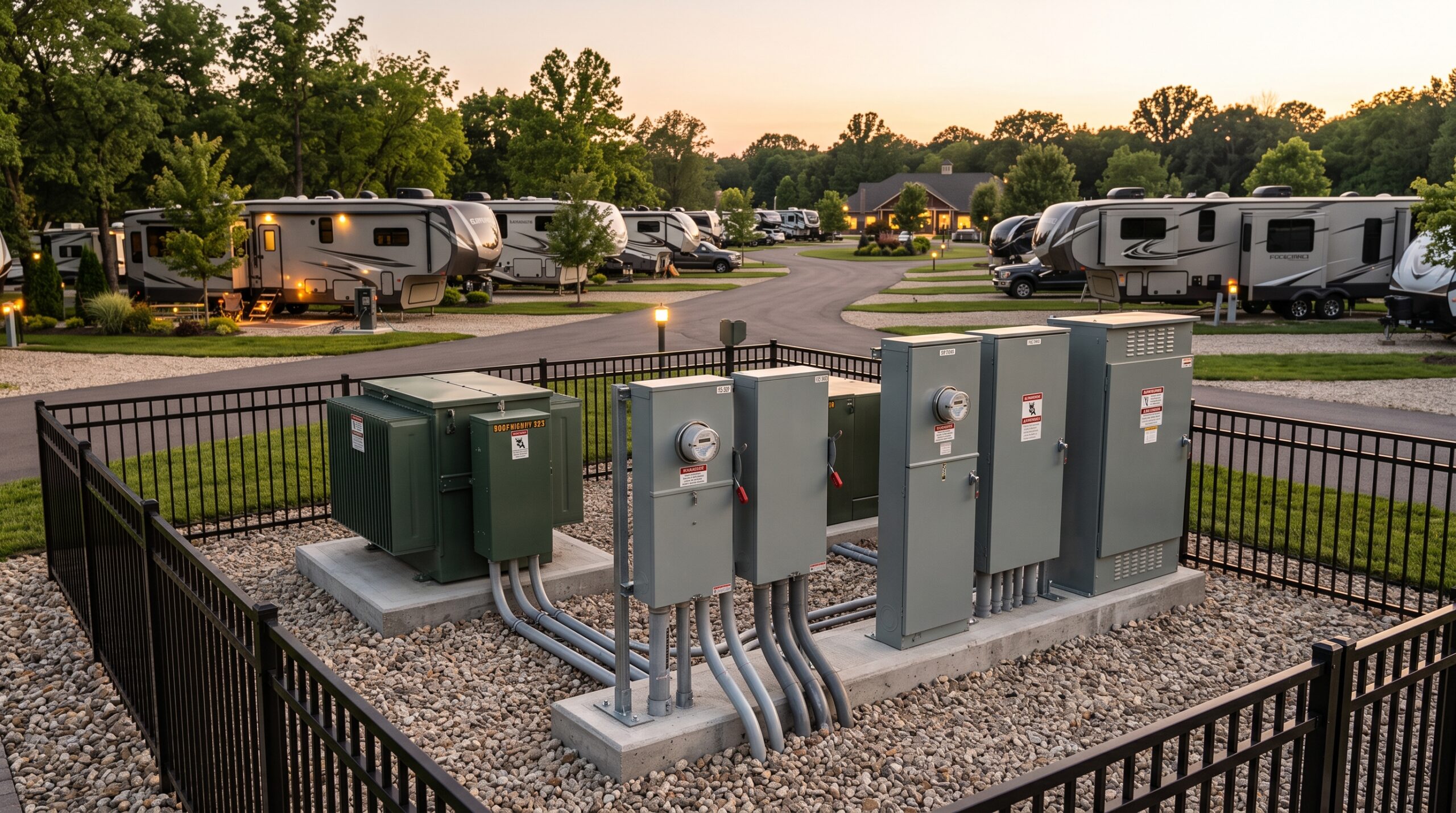
OHI lists the conditions a GMI checks for: open ground, compromised grounding, reverse polarity, voltage on the grounding conductor, and voltage that is too high or too low. In the field, these are the usual causes:
-
1
Missing grounding conductors
RV electrical expert Mike Sokol notes that parks built before about 1970 may have ungrounded three-wire distribution, which may mean trenching new grounding conductors to each pedestal.
-
2
Misplaced neutral-to-ground bonds
The bond belongs only at the service, never in pedestals or downstream subpanels. RVIA says to confirm neutral-to-ground isolation at every pedestal, because downstream bonding faults can trip GMIs.
-
3
Voltage drop
Electrical Works, writing for OHI, gives two examples: a 50-amp site 385 feet out on #8 copper drops 13% to 209V, and the last of nine daisy-chained 50-amp sites drops 14% to 206V. GMIs shut off at low voltage, so on full weekends this hits "multiple sites at once."
-
4
Worn receptacles and old pedestals
A loose plug in a worn receptacle can trigger a shutdown.
-
5
Ground rods as a "fix"
A ground rod is no substitute for a low-impedance grounding path back to the service.
Not every trip is the park's fault. The GMI also flags the guest's damaged cord or adapter.
How Existing Parks Should Audit and Upgrade
OHI and RVIA both say grounding problems are usually systemic, so the whole property should be evaluated. Fixing one site at a time is not enough. A sensible sequence:
- Hire the right electrician: a licensed, insured commercial contractor with NEC Article 551 and campground experience, equipped to measure ground continuity and neutral loop resistance, who delivers a written report.
- Specify the scope: visual inspection, ground continuity, neutral-to-ground isolation, neutral loop continuity, lug re-torque, and the main grounding system.
- Keep in-house checks basic. Trained staff can do visual checks, circuit-analyzer tests and hot-to-ground readings (below 114V, call an electrician). Plug-in testers give partial answers; OHI and RVIA recommend UL-listed GMI testers once available.
- Phase the fixes section by section if needed.
- Start now. OHI warns repairs "could take months of planning," and seasonal parks may lose a summer.
The reassurance: OHI's Riley Wilson says parks wired to prior NEC requirements shouldn't need rewiring for the 2026 code.
What Upgrades Cost: Only Ranges We Can Source
No authoritative industry benchmark exists yet; Sokol says a universal estimate is impossible without seeing the site. Published data points:
- CampLife (campground software) estimates $500-$2,000 per site for installing RV electrical hookups. Amperage and distance to the main power source drive the range.
- A municipal quote: in September 2026, Jamestown, Rhode Island, was quoted $875,000 for materials and electrical labor on new pedestals at 62 Fort Getty sites, excluding water meters and utility charges. That was about 80% above an estimate from nearly three years earlier; officials cited copper and labor costs and warned that shared switchgear doesn't prorate per site.
Cost drivers are consistent: trenching, rock, roots, road crossings, conductor size, service capacity and the utility. Budget from a site-specific electrician's scope.
Designing New Parks for GMIs
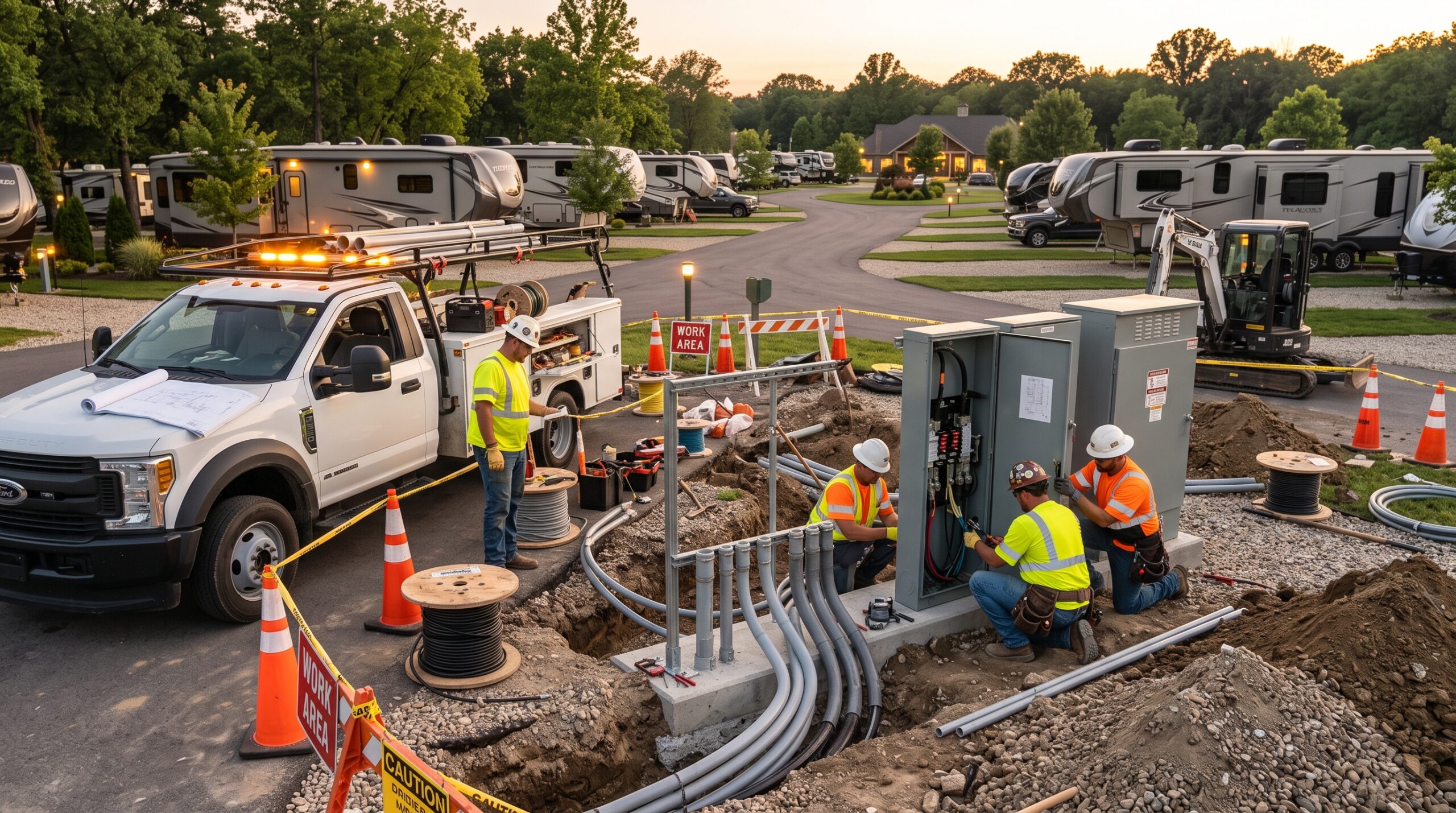
The cheapest time to get this right is before trenching:
- Plan 50-amp capacity. The NEC requires at least 40% of new RV sites (20% of existing sites) to have 50-amp receptacles. An informational note says seasonal parks may need close to 100%.
- Size conductors for voltage drop at full load, not just ampacity, and avoid long daisy chains.
- Use four-wire 120/240V distribution, neutral and ground separated at pedestals and bonded only at the service.
- Commission and document ground continuity and neutral loop tests.
Liability, Insurance and Documentation
GMIs have no manual override, and Sokol warns that defeating one creates serious liability if someone is hurt. Underwriters already ask: one RV park insurance application asks whether electrical work is done by a licensed electrician; another asks whether pedestals get a licensed electrician's inspection at least yearly. RVIA's best practice is the same annual inspection. Dated reports and repair records are the paper trail you want with your insurer or in court.
Guest Experience and the Front Desk
As Electrical Works puts it, guests "won't see a voltage issue - they'll see a park problem." RVIA's GMI Task Force is working so the industry knows how to respond when a GMI cuts power. Train staff to ask whether the rig is model year 2028 or newer, offer an alternate site while maintenance checks the pedestal, and explain calmly that a damaged cord or adapter can also cause a trip. A GMI controls shore power only, not the RV's 12-volt batteries or inverter. Log every incident by site; the pattern tells your electrician where to look.
The Texas Angle
Texas adopted the 2026 NEC statewide effective September 1, 2026. TDLR says all non-exempt electrical work, in city limits or the county, must now meet the 2026 NEC, performed by state-licensed electricians. And voltage drop is worst in hot weather under heavy A/C load, which describes a Texas summer.
What It Means for Buying, Selling and Valuation
GMIs turn electrical condition from a footnote into a line item.
Buyers should request recent electrical reports, pedestal ages, outage and complaint history, and peak-occupancy voltage readings, and on older parks budget for a property-wide electrician's evaluation during the inspection period.
Sellers do better documenting now. A current report and a completed or budgeted fix list let a buyer price known work instead of discounting for unknown risk, which tends to surface as late-stage renegotiation.
At North Star, we treat electrical condition like septic, water and roads: part of the capital plan behind a sound valuation.
Owner Checklist
Immediately
- Read the OHI and RVIA GMI resources (ohi.org/gmi, rvia.org/gmi)
- Hire a licensed commercial electrician with Article 551 experience for a property-wide evaluation
- Test ground continuity, neutral-to-ground isolation and neutral loop resistance at every pedestal
- Measure end-of-run voltage at peak occupancy
- Inspect docks separately under Article 555
Ongoing
- Replace worn receptacles and pedestals; re-torque lugs
- Identify and price any ungrounded three-wire distribution
- Schedule annual inspections; keep dated reports
- Create a front-desk script and incident log
- Buy a UL-listed GMI tester when available
- Fold findings into your capital plan and deal diligence
The Bottom Line
GMIs will make RV travel safer, and parks with sound systems have little to fear. The risk is in problems nobody has measured. Mid-2027 is close and electrical work takes time to plan and schedule. Owners who test now will be the ones whose guests never notice.
North Star Brokerage & Advisory
We work exclusively in outdoor hospitality across 21 states. If you want to talk through what GMI compliance means for your property's value or deal diligence, that conversation is worth having early.
Start the Conversation
This article is for general informational purposes and reflects conditions as of publication. It is not legal, electrical, or engineering advice. Consult licensed electricians and qualified professionals before undertaking any electrical work or making any investment decisions based on information described here.