May 06, 2026

If you've spent years or decades building an RV park, mobile home community, campground, marina, or boat and RV storage facility, the last thing you want is to hand a massive share of your life's work to the IRS the day you sell. The 1031 exchange is the single most powerful legal tool available to prevent exactly that.
A Century-Old Strategy That Still Works

The 1031 exchange isn't a loophole. It isn't a grey area. It has been part of the U.S. tax code since 1921 — over 100 years — and it remains one of the most widely used and well-established wealth-preservation strategies in American real estate. The underlying logic is simple and fair: if you sell an investment property and immediately reinvest those proceeds into another investment property, your economic position hasn't really changed. Congress agreed it would be unjust to tax a theoretical gain you haven't actually pocketed, so they built in a mechanism to defer it.
Named after Section 1031 of the Internal Revenue Code, a like-kind exchange allows an investor to sell one qualifying investment property and use the proceeds to purchase a replacement property of equal or greater value — deferring all capital gains taxes and depreciation recapture taxes in the process. The tax obligation doesn't disappear; it travels with you into the new asset. But as long as you continue to invest, it stays deferred.
The Core Rule
To complete a 1031 exchange, you must identify a replacement property within 45 days of selling your relinquished property, and close on that replacement property within 180 days. A qualified intermediary (QI) must hold the sale proceeds in the interim — you cannot touch the funds.
Why This Matters More for Outdoor Hospitality Owners
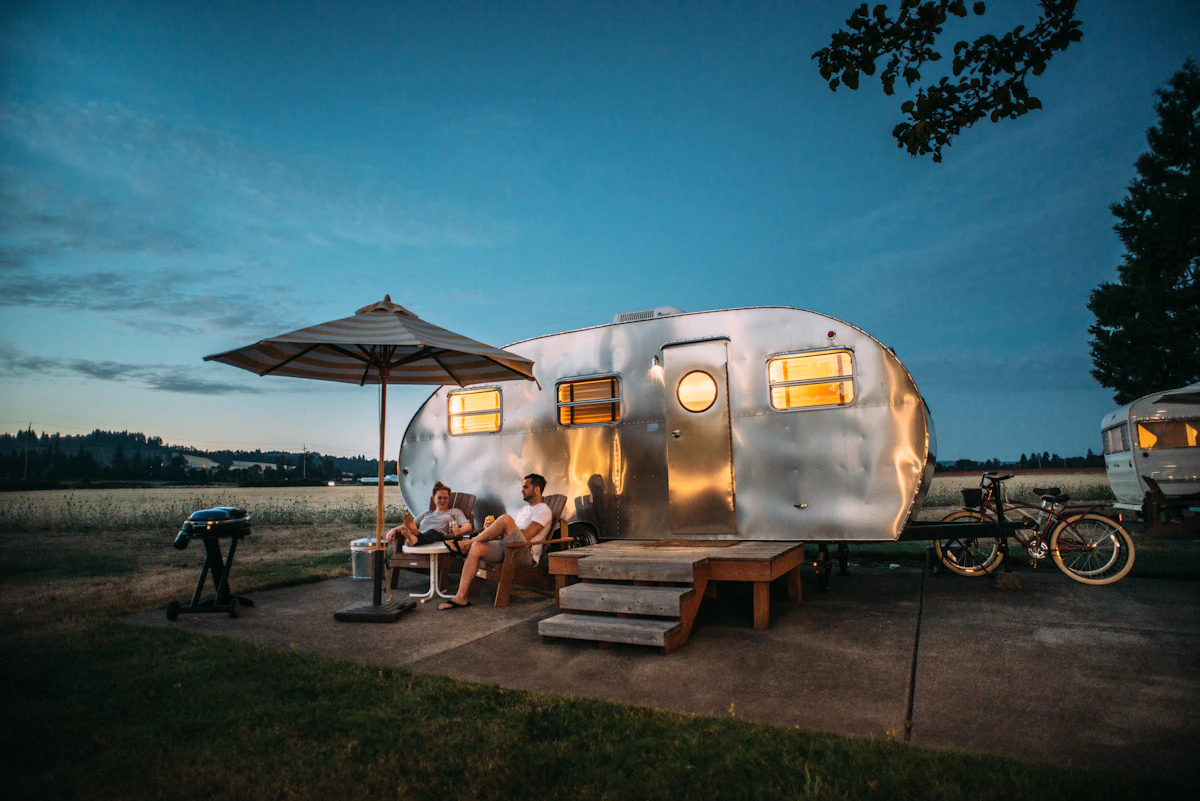
If you own an RV park, mobile home community, campground, marina, or storage facility that you've held for a long time, you're sitting on something most real estate investors only dream about: significant built-up equity. The combination of land appreciation (especially in markets like Austin, coastal areas, or growing Sun Belt communities), decades of depreciation taken on your improvements, and a strong operational income history means that when you sell, the tax exposure can be enormous.
We're talking about two distinct tax liabilities that come due simultaneously on a typical sale:
- Capital gains tax — federal long-term rates of up to 20%, plus applicable state taxes, on the appreciation in your property's value since you acquired it.
- Depreciation recapture tax — the IRS recaptures the tax benefit of every depreciation deduction you've taken over the years, at a rate of up to 25%. For owners who have held a property for 20, 30, or 40 years, this number can be staggering.
For many long-tenured outdoor hospitality owners, the combined tax burden represents 30% to 40% or more of their gross sale proceeds. A 1031 exchange is the only mechanism available under the tax code to legally mitigate, defer, or — when structured properly — ultimately eliminate these taxes entirely.
Your Replacement Property Options
Once you've sold your property and your qualified intermediary is holding the proceeds, you have several vehicles available for the replacement property purchase. Here's a plain-language overview:
The Strategy We Recommend: Single-Tenant Absolute NNN Properties
At North Star, our strongest recommendation for outdoor hospitality owners approaching retirement is to exchange into single-tenant, absolute triple-net (NNN) lease properties. These are properties leased long-term — typically 10 to 20+ years — to high-credit, nationally recognized operators. Think Dollar General, AutoZone, Tractor Supply, Starbucks, CVS, dental office chains, and veterinary clinic operators.
Under an absolute NNN lease, the tenant is responsible for virtually every ownership obligation: property taxes, insurance, utilities, maintenance, and management. As the landlord, your responsibilities are essentially zero. You own the dirt and the building. You collect a check.
This is a fundamentally different ownership experience than what outdoor hospitality operators are accustomed to. There are no residents to manage, no utility headaches, no staff to oversee, no seasonal income variability. These assets are designed to be owned passively — and they are, in our view, the ideal retirement vehicle for the outdoor hospitality owner who has spent a lifetime building something valuable and now wants to enjoy the rewards of it.
"Swap Till You Drop" — The Long Game
Here is where 1031 exchange strategy becomes genuinely powerful over a lifetime. The deferral carries forward into every subsequent exchange. As long as you continue reinvesting into qualifying replacement properties, the accumulated tax liability stays deferred — potentially indefinitely.

Investors who understand this use a strategy commonly known as "swap till you drop." The "drop" is not a market crash — it's death. When a property owner passes away, the cost basis in their real estate holdings resets to current fair market value. This is called a step-up in basis, and it is one of the most significant wealth-transfer benefits in the tax code. Your heirs inherit those properties at today's value, not what you paid for them — meaning they could sell the next day and owe none of the capital gains taxes that had been accumulating for decades.
Practically speaking, this means your RV park or campground — which you've held for 30 years and have depreciated aggressively — could be exchanged into a portfolio of NNN assets that you hold for the rest of your life. Your children or spouse inherit that portfolio with a clean slate. They can sell immediately, reinvest and continue holding, or simply keep collecting the passive income. Any of those options are made dramatically better by the step-up in basis.
The Step-Up in Basis Explained Simply
You bought your RV park in 1985 for $500,000. Today it's worth $8 million. If you sell without a 1031 exchange, you owe taxes on the $7.5 million gain plus depreciation recapture. If you exchange into NNN properties and hold them until death, your heirs inherit at the $8 million basis. They sell for $8 million. Taxable gain: $0.
Who Should Be Thinking About This Right Now
A Note on Working with the Right Team
A 1031 exchange is a legal and financial transaction with strict deadlines and serious consequences for errors. Identifying the right replacement properties within the 45-day window — and closing within 180 days — requires a team that already has deal flow, relationships with quality NNN sellers, and the operational capacity to move quickly.
North Star specializes exclusively in outdoor hospitality real estate: RV parks, mobile home communities, campgrounds, marinas, and boat and RV storage facilities. We understand the unique financial profile of these assets, the tax complexity that long-term ownership creates, and the replacement property landscape for owners transitioning to passive income. Our advisory work extends well beyond the sale itself — we stay with our clients through the exchange, the reinvestment, and the long-term portfolio strategy.